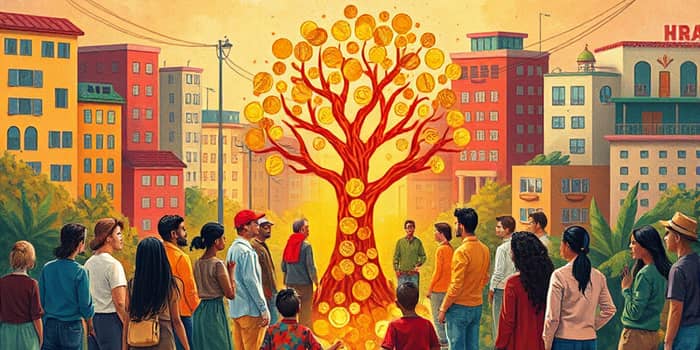
Community-driven projects transform neighborhoods, but securing funding can feel like navigating a labyrinth. By mapping the full spectrum of capital sources, understanding policy shifts, and adopting innovative tools, local leaders can unlock resources to fuel their vision.
In 2024, U.S. charitable giving soared to record-level philanthropic capital flows totaling $592.5 billion, marking unprecedented opportunity for social impact. Yet distribution remains uneven, with certain sectors thriving while others struggle.
Breaking down contributions reveals both scale and direction of funds:
This macro context underscores two key insights: individuals remain the primary funders, while institutional sources wield influence through large-scale grants. Community efforts must align with both grassroots generosity and institutional priorities.
Despite record totals, many nonprofits face increased compliance and reporting burden as federal budgets tighten. One-third of U.S. nonprofits rely on government support, exposing them to shifts in:
• Grants for housing assistance, after-school programs, and mental health services. • DOJ funding for violence prevention cut by $169 million. • Delays in disbursement from HUD, EPA, HHS, and DOE.
These headwinds force community organizations to adapt, diversify revenue, and build reserves against uncertainty.
As federal grants retract, state and local governments are stepping in with targeted capital. California, Colorado, New York, and Illinois lead with new public health, climate resilience, workforce, and housing initiatives.
Centralized portals like the California Grants Portal and Colorado Grants Guide simplify discovery, but come with rigorous performance metrics and reporting. Balancing opportunity with obligation, organizations can:
• Align proposals with state-defined priorities. • Strengthen data and evaluation capacity. • Manage compliance through dedicated staff or partnerships.
Corporate giving reached a record $44.40 billion in 2024, fueled by rising ESG commitments. Unlocking this capital often requires crafting cross-sector partnership models gaining traction that merge community goals with business strategies.
Success hinges on clear impact metrics, shared governance, and alignment with corporate talent or market objectives.
The digital era has reshaped donor expectations. Younger supporters demand transparency, community involvement, and immediacy. Effective initiatives adopt personalized digital-first engagement strategies to build trust and scale support.
A robust online presence signals credibility to both individual donors and institutional funders, making digital literacy a core competency.
Major funders increasingly back systems-change approaches that combine direct service with advocacy. Organizations integrating policy work can access larger, multi-year grants from entities like the Ford Foundation and Open Society Foundations.
By building lobbying capacity, coordinating sector-wide messaging, and demonstrating policy wins, community groups become magnets for sustained investment.
Universities and research institutions are channeling funds into local collaborations. Programs such as UCLA’s Community-Engaged Research Grants offer seed funding and project-scale support, bolstering:
• Exploratory partnerships between faculty and community leaders. • Seed grants for pilot programs in equity and social justice.
These institutional grants not only provide capital but also technical expertise, evaluation support, and credibility to emerging initiatives.
Unlocking capital for community initiatives demands strategic agility, collaborative mindsets, and narrative clarity. By mapping the full funding landscape, diversifying revenue streams, and embracing both digital and civic engagement, local leaders can secure the resources needed to drive long-term impact.
Armed with insights into macro trends, policy shifts, and innovative partnership models, community organizers and nonprofit leaders can transform uncertainty into opportunity—building vibrant, equitable, and resilient neighborhoods for all.
References