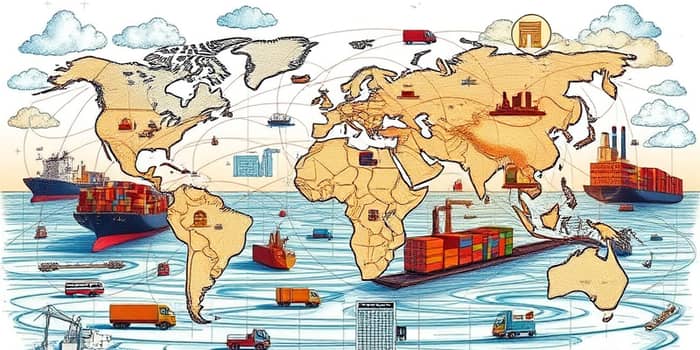
Supply chains have evolved from linear, cost-focused systems into dynamic, interdependent networks. As disruptions escalate in frequency and complexity, businesses face an urgent imperative to transform.
In 2025, supply chain disruption notifications surged by 38% year-over-year, establishing disruption as the new constant. What was once an occasional crisis has become a baseline operating condition. Companies cannot afford to treat interruptions as exceptions; instead, they must embed resilience into every aspect of planning and execution.
Leaders now recognize that resilience and agility are strategic differentiators rather than mere operational niceties. Firms that anticipate, absorb, and adapt to shocks gain a definitive competitive edge in volatile markets.
Disruptions are no longer isolated. They stack, compound, and cascade across every link in the chain. Human-health disruptions skyrocketed by 143%, regulatory changes climbed 92%, and cyber events jumped 64%. Geopolitical instability grew 54%, while extreme weather and flooding rose by over 33% each.
Every hour spent manually validating impact translates into lost revenue and market share, as competitors secure alternative capacity. Speed of response is now a financial metric, reflecting how quickly an organization can pivot when the unexpected hits.
Understanding root vectors is essential for designing effective responses. Below is a summary of primary risk vectors and their recent growth metrics:
The market ramifications of these disruptions span operational, financial, and strategic domains. At the operational level, manual workflows struggle to keep pace with accelerated incident rates. Delayed insights directly erode profitability and customer trust.
Financially, companies face mounting pressure to optimize costs amid economic uncertainty. Global debt levels rise, consumer spending decelerates, and housing market softness depresses demand in furniture and household sectors. Underutilized capacity becomes an unsustainable expense, forcing consolidation or closures.
Multiple forces converge to drive this new reality. Geopolitical volatility and shifting trade policies introduce unpredictable tariff structures and barriers. Rapid regulatory changes challenge compliance teams, while cyber threats exploit technological dependencies. Extreme weather, fueled by climate change, further disrupts transportation and manufacturing.
Compounding these factors are workforce challenges—aging leadership, labor shortages, and the urgent need for digital skills. Traditional planning systems, built for stable conditions, falter when faced with intertwined risks and dynamic priorities.
Organizations are shifting from reactive crisis management to proactive resilience design. This evolution begins with integrated scenario planning, leveraging AI and predictive analytics for real-time insights. Digital Twins model network behavior under various stress scenarios, enabling teams to anticipate bottlenecks and reroute flows before disruption strikes.
Nearshoring and dual sourcing reduce dependencies on distant suppliers. Regional-for-regional systems, supported by robust data infrastructure, replace sprawling global networks optimized solely for cost.
Digital technologies underpin modern resilience strategies. Key solutions include:
By investing in end-to-end visibility platforms, organizations can detect early warning signals, synchronize responses, and maintain continuity despite sudden shocks.
Effective resilience demands cultural and structural changes. Leaders must transition from managing linear processes to orchestrating intelligent, adaptive networks. Cross-functional collaboration and ecosystem synchronization become central tasks, involving suppliers, technology vendors, and logistics partners in unified decision loops.
Teams embed risk management into daily operations rather than treating it as an isolated function. Continuous modeling of alternative sourcing, transportation modes, and region-specific regulations ensures agility becomes a permanent capability.
Resilience is no longer a cost center—it is a strategic investment that creates value. Organizations that master orchestration across digital and physical networks can:
Orchestration, not control, defines success in a world where no single organization can prevent every disruption. By shaping digital infrastructures, influencing public policy, and forging collaborative ecosystems, companies can turn uncertainty into opportunity.
The permanent integration of resilience into supply chain logic marks a fundamental shift. Businesses that embrace this paradigm will thrive, while those clinging to outdated models face existential risk. The time to act is now: build agility into your networks, leverage cutting-edge technologies, and transform leadership mindsets to secure sustained competitive advantage.
References