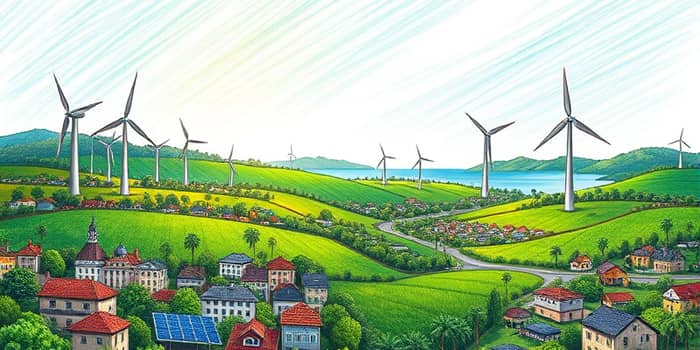
As the climate crisis intensifies and resource constraints tighten, the urgent question looms: how do we finance the transition to a resilient, low-carbon world? Across sectors and borders, we must mobilize unprecedented volumes of capital to drive innovation, equity, and environmental stewardship. This article explores why massive new green capital is needed, how large the funding gap truly is, where the greatest opportunities and bottlenecks lie, and which policy and market levers can unlock that capital at scale.
Over the past decade, environmental, social, and governance (ESG) considerations have reshaped global capital flows. In 2024, the sustainable finance ecosystem achieved remarkable growth, demonstrating both investor appetite and policymaker commitment to channel funds toward projects that protect the planet and uplift communities.
The sustainable bond universe experienced record issuance, topping $1,052 billion in 2024. Green bonds led the charge, but social, sustainability, and sustainability-linked instruments collectively represent more than one-third of the market.
Looking ahead, Moody’s forecasts global sustainable bond issuance around $1 trillion in 2025, maintaining momentum even as the market matures. Transition-labeled and SLBs are evolving, while social bonds await more benchmark-sized projects.
Public sector labeled bonds also scaled up, with cumulative issuance reaching $6.1 trillion by March 2025. In Q1 2025 alone, $252 billion of these instruments were issued, underscoring government commitment to resilience and clean energy.
Geographically, Europe remains the powerhouse for sustainable fund assets and inflows. The United States, grappling with anti-ESG sentiment and regulatory shifts, saw net outflows of $20 billion in 2024. Emerging markets are advancing frameworks, but still face challenges in data, risk perception, and investor confidence.
Despite trillions mobilized, the financing gap remains daunting. According to the Climate Policy Initiative, $6.3 trillion is needed annually through 2030 simply to avert the worst climate impacts. Bridging this divide requires innovative financing structures and a dramatic scale-up in private sector participation.
Simultaneously, achieving the United Nations Sustainable Development Goals by 2030 demands an additional $4 trillion each year beyond current commitments. This imperative has sparked calls for tripling multilateral development bank lending capacity and leveraging blended finance to attract private investors.
Nature itself offers vast economic potential. The World Economic Forum estimates $10 trillion in annual business opportunities and nearly 400 million jobs by 2030 from biodiversity, water, and soil conservation. Yet realizing these gains hinges on investment in nature-positive solutions, which currently attract only a fraction of required capital.
Agrifood systems, responsible for 10% of global GDP and 40% of jobs, are exceptionally vulnerable to climate shocks. Finance for these systems jumped over 300% since 2019, now reaching $95 billion annually—still less than 5% of the $1.1 trillion needed each year for modernization and resilience.
Critical infrastructure underpins every transition. Modern grids, long-duration storage, resilient ports, and digital platforms form the backbone of a decarbonized economy. Experts estimate $600 billion of annual investment is required by 2030 to address grid congestion in Europe and persistent power shortages in the Global South.
The narrative of sustainable finance is one of both rapid advancement and growing pains. For five consecutive years, sustainable debt issuance has exceeded $1 trillion annually, illustrating a movement from niche to mainstream in global capital markets.
Emerging and developing economies are building regulatory frameworks and adopting best practices, expanding the reach of green, social, and sustainability instruments beyond traditional markets. Innovations in blended finance and de-risking tools are enabling projects in lower-income countries to attract reputable private investors.
Yet investor caution has emerged. Sustainable fund launches declined by 45% in 2024, and median returns lagged traditional funds, intensifying scrutiny and spurring net outflows in key markets. Anti-ESG rhetoric, elevated interest rates, and regulatory uncertainty have dampened enthusiasm in the United States and elsewhere.
Market integrity remains a central concern. Heightened scrutiny of greenwashing, evolving standards for transition finance, and calls for robust disclosure frameworks are shaping the next phase of growth. Over one-third of new policy measures in 2024 focused on transparency, reflecting the importance of credible data in unlocking confidence.
Global collaboration is deepening through networks and platforms that benchmark and support sustainable finance initiatives. The Sustainable Banking and Finance Network’s 2025 report tracks progress in 72 emerging economies, assessing three critical pillars:
Meanwhile, the International Platform on Sustainable Finance is integrating biodiversity considerations into transition finance frameworks, aiming for tangible outcomes rather than mere reporting. Country examples illustrate rapid progress: by mid-2025, China’s outstanding green loans reached RMB 42.39 trillion, and green bond issuance surpassed RMB 4.6 trillion.
Policy and market tools are expanding to mobilize capital at scale: carbon pricing mechanisms are maturing, blended finance structures are de-risking early stages, and enhanced disclosure requirements are building transparency. Development finance institutions are shifting from grant models to investable platforms that crowd in commercial investors.
Together, these frameworks and innovations create a fertile environment for channeling funds into projects that deliver both financial returns and sustainable impact. The challenge now is to connect ambition with execution, ensuring that capital flows to the most transformative solutions.
As we gaze toward the horizon, the convergence of policy, finance, and entrepreneurship can create a resilient, equitable future. By embracing collaboration, innovation, and rigorous standards, we can unlock that capital at scale and empower communities worldwide to thrive in harmony with nature.
References