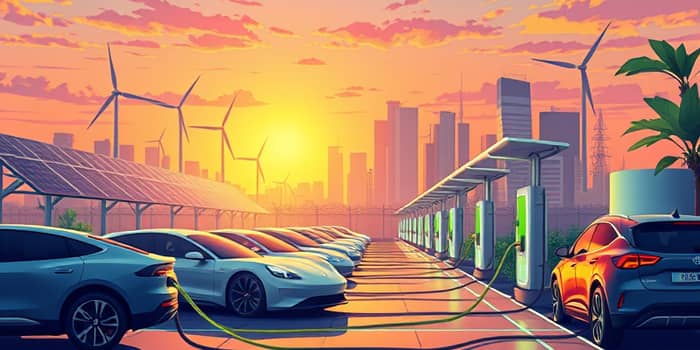
The global transition to electric mobility is not just about technology—it’s a revolution powered by capital, policy and innovation. As EV adoption accelerates, understanding the financing ecosystem becomes critical for investors, automakers and policymakers alike.
Electric vehicles are transforming markets at an unprecedented pace. Major research houses forecast that EVs will account for roughly one in four new cars sold worldwide in 2025, with regional dynamics shaping the trajectory.
Looking beyond 2025, analysts expect sustained growth. Published forecasts include:
• 22.1 million EV sales globally in 2025, about 24% of light-vehicle volume.
• expansion of lithium-ion cell capacity to 3.8 TWh by end-2025—nearly double projected demand.
• a peak in road-transport oil demand this decade, driven predominantly by electrification.
These projections underscore the need for a robust financing infrastructure, as overcapacity risks in battery manufacturing could reshape cost curves and investment returns.
Financing the vehicles themselves remains the foundation of adoption. Traditional auto loans and leases still dominate, but the EV landscape introduces unique factors:
Charging networks are the arteries of electrification, requiring capital at scales historically unseen in the auto sector. Funding sources vary by deployment type:
The upstream industrial ecosystem—from lithium mines to gigafactories—represents perhaps the largest capital sink. Expanding cell manufacturing capacity by nearly 4 TWh by 2025 will require tens of billions of dollars across multiple jurisdictions.
Green bonds, project debt and equity remain the primary vehicles for large-scale industrial build-out, while venture capital and strategic corporate investors target next-generation cell chemistries and recycling technologies.
Policymakers worldwide are deploying incentives—tax credits, rebates and mandates—to accelerate EV uptake, yet the stop-start nature of programs introduces risk for financiers and OEMs. Managing these uncertainties requires innovative instruments:
• Green bonds and sustainability-linked loans tie capital costs to decarbonization targets, attracting ESG-focused investors.
• Securitization of EV leases and loans can unlock liquidity, spreading risk across capital markets.
• Carbon credit markets and renewable energy certificates provide ancillary revenue streams for charging operators.
• Fintech platforms are enabling peer-to-peer loan marketplaces and usage-based insurance tailored to connected EV data.
The financing architecture supporting the EV revolution must be as dynamic as the technologies it underpins. Stakeholders should consider collaborative strategies:
• Aligning public incentives with private funding to de-risk early deployments.
• Leveraging blended finance structures—combining concessional and market-rate capital—to optimize returns.
• Investing in data platforms for robust battery health reporting and utilization forecasting.
• Encouraging standardized green bond frameworks to funnel global capital into sustainable mobility assets.
As EV adoption accelerates toward mass market scale, the interplay of policy, finance and innovation will determine how swiftly—and equitably—we drive toward a decarbonized future. By embracing flexible financing models and emerging instruments, investors and policymakers can ensure the transition is not only technologically transformative, but also financially sustainable.
References