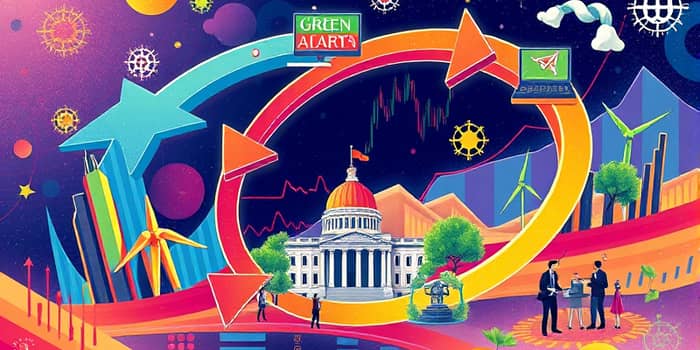
In an interconnected world, markets and policy-making are bound by continuous interactions. What begins as a policy decision can reshape markets, which in turn feed back into the policy process, creating cycles that either amplify trends or restore equilibrium. Understanding these loops is essential for leaders, investors, and citizens seeking to navigate complex economic and environmental challenges.
By exploring the mechanisms, real-world cases, and strategies to harness these dynamics, this article offers both inspiration and practical guidance for stakeholders aiming to build resilient systems and drive positive change.
Feedback loops describe processes where the output becomes a new input, reinforcing or balancing the original action. When effects compound, we see a self-reinforcing (positive) dynamics, like asset bubbles powered by speculative investment. Conversely, negative or balancing loops maintain stability, as when central banks raise rates to cool inflation.
These cycles underpin many market-policy interactions. Prices, investor sentiment, and volatility act as signals that guide policymakers, who then adjust rules or interventions. Recognizing these patterns allows decision-makers to anticipate unintended outcomes, seize opportunities, and mitigate risks.
Markets convey signals through multiple channels:
Beyond financial metrics, investor demands—particularly around ESG—shape corporate reporting and environmental regulations, creating a rapid, aggregated signals via prices that policymakers cannot ignore.
Examining practical cases sheds light on both virtuous and vicious cycles:
In climate and sustainability policy, feedback loops can be a powerful ally. By systematically monitoring emissions, consumer behavior, and technological advances, policymakers can adapt regulations to catalyze innovation and equitable outcomes.
Key practices include:
Modern research views policy-market interactions through the lens of complex adaptive systems. Rather than linear cause-and-effect, these systems feature multiple feedback channels, power dynamics, and emergent behaviors. Scholars warn that interventions may trigger unforeseen loops, underlining the importance of robust evaluation and scenario planning.
Critics argue that predictive power is limited by human behavior and external shocks. While positive loops drive growth and innovation, they can also sow the seeds of instability. Negative loops stabilize but may impede necessary transformation, as seen when stringent regulations provoke political backlash.
To leverage feedback loops effectively, stakeholders should:
By adopting these approaches, policymakers and market participants can create virtuous sustainability cycles that balance growth, equity, and environmental stewardship.
Feedback loops between markets and policy are not mere academic curiosities; they lie at the heart of economic resilience and sustainable progress. Recognizing and skillfully managing these dynamics empowers decision-makers to anticipate shifts, avoid crises, and amplify beneficial outcomes.
As we face pressing challenges—climate change, financial stability, and social equity—the ability to navigate cyclical interactions will define success. Through informed strategies and collaborative innovation, we can harness the power of feedback loops to build a more prosperous and sustainable future for all.
References