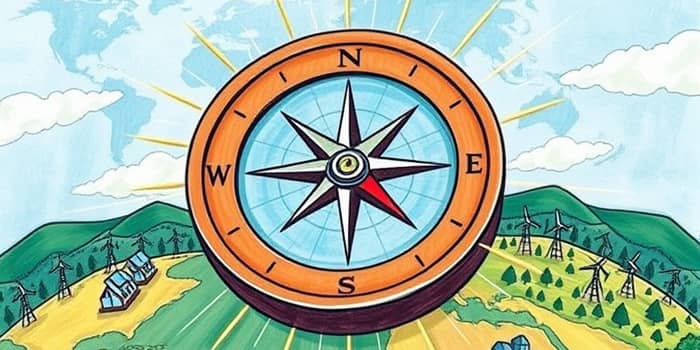
As the impacts of climate change intensify, the global community faces an unprecedented challenge: mobilizing enough capital to transform economies, protect communities, and safeguard natural systems. The concept of a “Climate Finance Compass” offers a powerful metaphor—and a practical tool—to navigate this complex terrain and align every dollar with a sustainable future.
In this article, we explore four pillars of the Climate Finance Compass: where we stand today, why the architecture demands reform, how new frameworks guide decisions, and what course corrections are essential by 2030–2050.
Climate finance, as defined by the UNFCCC, encompasses investments—public, private and alternative sources—that fund projects for mitigation, adaptation, and loss and damage. Despite growing attention, total global flows reached only around USD 650 billion per year, far short of the urgent needs.
Mitigation efforts aim to reduce greenhouse gas emissions through renewable energy and low-carbon transport. Adaptation focuses on resilient infrastructure and early warning systems, while loss and damage addresses unavoidable impacts that exceed mitigation or adaptation capacities.
To achieve the Paris Agreement’s goals, the world must decarbonize seven times faster and deploy almost USD 200 trillion in climate finance by 2050. This implies a five-fold increase in annual flows, demanding more than incremental adjustments—it requires a systemic shift.
The international financial architecture (IFA) comprises multilateral development banks, development finance institutions, private banks, central banks, and global standards. While this network channels vast sums worldwide, it remains fragmented, risk-averse, and misaligned with climate imperatives.
Key barriers include complex procedures, insufficient fiscal space in vulnerable countries, and lack of risk-sharing mechanisms. The Climate Policy Initiative asserts that holistic reform of the international financial architecture is non-negotiable if we are to scale capital effectively.
Emerging markets and developing economies (EMDEs) face acute challenges: higher project risks, underdeveloped ESG frameworks, and capital under-allocation. Developed countries must fulfill the USD 100 billion annual promise, double adaptation finance, and establish loss and damage arrangements to close the gap.
The Climate Finance Reform Compass is an action-oriented platform that translates high-level commitments into pragmatic milestones. It tracks progress across nine thematic reform areas, aligning with the COP28 Global Climate Finance Framework and offering transparency, accountability, and coordination.
As a living tool, the Compass outlines around thirty key reforms with status indicators, resources, and 2030 targets, enabling stakeholders—governments, MDBs, private investors, and civil society—to align efforts and measure results.
Each chapter of the Compass details: global frameworks (COP decisions, G20 communiqués), concrete milestones for 2030, and the actors responsible for driving reforms, whether sovereigns restructuring debt or private banks deploying blended finance.
Charting a sustainable course requires targeted course corrections across four fronts:
Private finance remains indispensable. Governments and MDBs cannot close the trillions-dollar gap alone. Clear taxonomies, rigorous data, and safeguards against greenwashing will unlock transition finance for EMDEs.
Concessional capital must de-risk investments, while robust carbon markets provide price signals aligned with national climate targets. Ensuring a just and equitable transition also demands social protections and labor policies that leave no one behind.
The Climate Finance Compass is more than a map—it is a call to action. It invites every stakeholder to align strategies, drive reforms, and accelerate capital flows. By 2030, the world must have shifted from fragmented efforts to a coordinated surge of investments that preserves ecosystems, fortifies communities, and propels economies into a sustainable era.
At this critical juncture, ambition without execution is insufficient. We must leverage the Compass to ensure that every policy decision, every financial innovation, and every dollar invested steers us towards a resilient, low-carbon future. The journey ahead is daunting, but with clarity, collaboration, and conviction, we can chart a course towards sustainability that endures for generations to come.
References