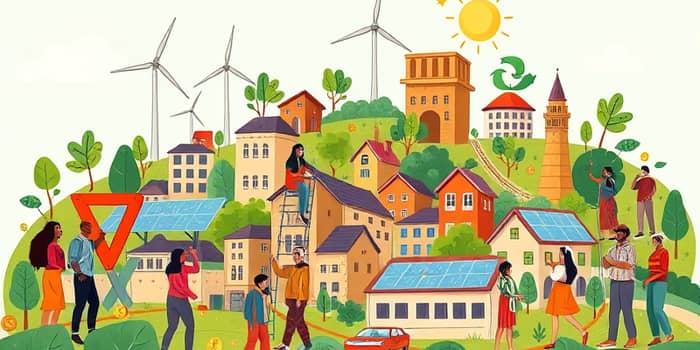
Capitalism has long driven innovation and growth, but its unchecked course has generated deep inequalities and environmental crises. Today, an emerging wave of social finance is harnessing market mechanisms to deliver not only profits, but also positive social and ecological outcomes.
By weaving impact considerations into every investment decision, this movement aims to fundamentally internalize social and environmental outcomes and redefine the purpose of capital for the 21st century.
Over recent decades, investors and policymakers have moved beyond pure profit metrics. They now integrate environmental, social, and governance factors into risk assessments and capital allocation. This shift represents a paradigm where money markets prioritize people and planet alongside returns.
As sustainable finance expands, it challenges traditional profit-only models and opens pathways for inclusive, resilient economies.
The sustainable finance sector has mushroomed into a global powerhouse. Recent data underscores the speed and scale of this revolution.
Regional leadership varies. Europe commands roughly 40% of sustainable finance today, while Asia-Pacific is on track to become the fastest-growing market. Emerging economies, supported by networks like the Sustainable Banking and Finance Network, are issuing nearly $790 billion in thematic bonds.
Several powerful forces are steering capital markets towards outcomes that benefit society as a whole.
These drivers create a feedback loop: as climate events intensify and social fissures deepen, more capital flows into solutions that mitigate risk while generating returns.
Social finance reshapes capitalism through three key channels:
These mechanisms realign incentives, ensuring that corporations internalize the true costs of their operations and work towards sustainable outcomes.
To harness the full potential of social finance, stakeholders can adopt the following strategies:
By taking these steps, the financial ecosystem can continuously evolve to address pressing global challenges.
The social finance revolution is more than a trend—it is a transformative movement. It shows that markets can be powerful engines for social progress when guided by purpose as well as profit.
Imagine a world where every dollar invested in infrastructure also strengthens community well-being, where private banks finance healthcare access alongside economic growth, and where pension funds support clean technology with equal zeal as they pursue returns.
Such a future demands collective action. Investors must champion transparency and impact; corporations must embed sustainability into their core strategies; governments must create enabling environments with clear rules and incentives.
The reshaping of capitalism through social finance offers a path to more equitable, resilient, and sustainable economies. By internalizing externalities, directing capital to where it matters most, and aligning market incentives with social goals, we can redefine success in financial terms that honor both people and planet.
This revolution is already underway. As stakeholders across sectors embrace these principles, we stand on the brink of an economic system that truly values shared prosperity and environmental stewardship. The time to act is now—together, we can build a capitalism fit for the challenges of our age.
References