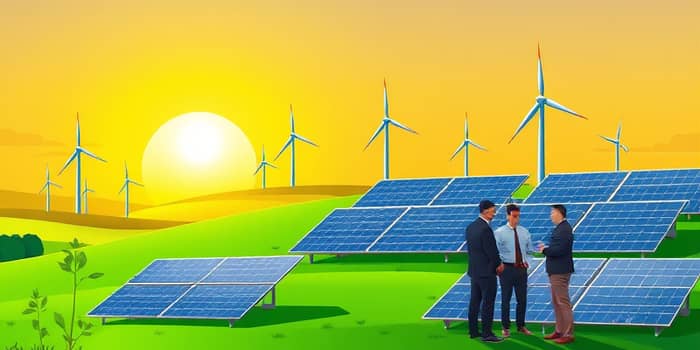
As the world grapples with climate change and economic uncertainty, capital is decisively flowing into clean energy. Investors, corporations, and governments are aligning profit motives with planetary health in unprecedented ways.
In 2025, total global energy investment is expected to reach about USD 3.3 trillion, marking a pivotal moment in the transition to sustainable energy. Of this sum, roughly USD 2.2 trillion flows into clean energy—nearly twice the amount directed toward fossil fuels.
This structural reallocation underscores a clear message: capital is structurally shifting toward renewables, grids, storage, low-emissions fuels, efficiency, and electrification. Solar energy, in particular, now holds the top spot, with an anticipated USD 450 billion dedicated to utility-scale and rooftop installations in 2025 alone.
The first half of 2025 witnessed a record-setting USD 386 billion invested in new renewable projects globally, a 10% increase over the same period in 2024. Investors are favoring small-scale distributed solar and offshore wind, which offer more attractive returns and manageable project timelines.
Despite strong global momentum, the United States experienced a notable decline in 1H 2025, with clean project spending down USD 20.5 billion (–36%) compared to late 2024. This pullback reflects post-election policy uncertainty and trade tensions, prompting developers to front-load projects in late 2024 to secure tax benefits.
The Clean Investment Monitor reports that Q1 2025 saw USD 67.3 billion invested in US clean energy and transportation, up 6.9% year-on-year. Consumer-driven segments—rooftop solar, electric vehicles, and heat pumps—accounted for nearly half of this total, demonstrating the rising consumer-driven clean investment trend.
Within utility-scale clean electricity, solar and storage commanded USD 14.4 billion, while wind investments rebounded to USD 3.9 billion—an encouraging uptick of 26.8% quarter-on-quarter. New project pipelines remain robust, with USD 41.3 billion in upcoming utility-scale announcements.
Across renewables, storage, grids, and emerging transition technologies, certain themes are coming to the fore:
Solar PV is the single largest category in global energy investment, outpacing oil upstream spending for the first time. With at least 620 GW of new capacity expected in 2025, solar may soon exceed gas and coal in total capacity additions.
Onshore wind is experiencing a transitional phase. While onshore project finance dipped, offshore wind’s momentum and onshore policy improvements in select markets signal long-term growth prospects.
Electrification and decentralized renewables drive demand for flexible, resilient networks. Grids require upgrades and expansion, while storage projects—from lithium-ion batteries to emerging long-duration technologies—are securing increasing slices of the investment pie. This variable renewables plus gas model, backed by firm power sources such as nuclear and hydro, is reshaping baseload dynamics.
Beyond renewables, nuclear power and low-carbon fuels are gaining traction. Investment in nuclear has grown 50% over five years, and 2025 spending on new plants and upgrades is set to exceed USD 70 billion. Small modular reactors offer modular scalability and enhanced safety features.
Green hydrogen and carbon capture technologies, included in the USD 670 billion cleantech supply spending, are central to decarbonizing heavy industry. Regions like Europe, India, and the Middle East are vying for leadership in these sectors, linking industrial strategy with export potential.
Corporate procurement of clean energy is reaching new heights. Data centers, in particular, are adopting sophisticated hourly matching of consumption with renewable generation profiles. AI and digital tools optimize asset performance, streamline operations, and reduce costs, making clean energy both a strategic and economic imperative.
For investors looking to align returns with impact, several practical steps can guide decision-making:
By adopting these approaches, investors, developers, and policymakers can capitalize on the unprecedented momentum behind clean energy. The convergence of strong long-term pipelines, technological innovation, and shifting capital flows presents a historic opportunity to power both profits and the planet.
Renewable energy investment is more than a financial trend—it represents a fundamental transformation of the global energy system. With strategic vision and continued collaboration, stakeholders can ensure that the clean energy revolution delivers robust returns while safeguarding the environment for generations to come.
References