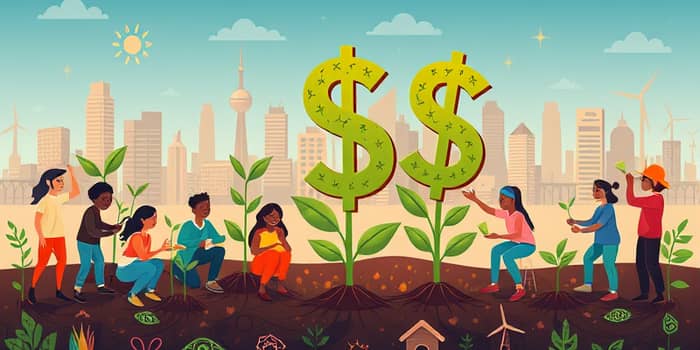
In an era marked by widening inequalities and environmental challenges, social finance emerges as a transformative force. It steers capital toward initiatives that not only generate returns but foster thriving communities, resilient economies, and a healthier planet. By illuminating the path from philanthropy to market-based solutions, social finance redefines what it means to invest in our collective future.
As we explore this evolving landscape, we will uncover the spectrum of instruments available, examine the surge in global capital flows, and outline practical strategies for stakeholders to maximize both impact and financial return. Our journey begins by setting the conceptual foundation.
At its core, social finance leverages financial tools and capital for societal good. Unlike traditional investing paradigms that focus solely on risk and return, social finance prioritizes measurable social outcomes alongside financial gains. This dual mandate sits within the broader framework of sustainable finance, often encapsulated by the ESG—environmental, social, governance—lens.
The spectrum of social finance stretches from market-rate impact funds to concessionary grants, with instruments such as social impact bonds, community development finance, and microfinance vehicles. Each instrument is tailored to address specific challenges—whether reducing recidivism, expanding educational access, or fostering climate resilience in vulnerable populations.
Key debates in this field hinge on the balance between “impact-first” and “finance-first” approaches, the potential for social finance to complement or substitute public spending, and the ever-present risk of impact-washing. Navigating these debates requires robust measurement frameworks and a commitment to equity.
Social and sustainable finance have witnessed explosive growth. In 2024, UNCTAD estimated that global sustainable finance surpassed US$8.2 trillion, a 17% increase from 2023. Industry forecasts see this market soaring to nearly US$38.2 trillion by 2034, propelled by a 19% compounded annual growth rate.
Despite headwinds, sustainable bond issuance approached US$975 billion in the first seven months of 2025, reflecting robust demand across themes. Emerging markets, led by member countries of the Sustainable Banking and Finance Network, issued US$790.5 billion in thematic bonds, representing 94% of all issuance in those regions.
Europe remains the largest regional hub, commanding roughly 40% of the market. However, Asia-Pacific is on track to record the fastest growth between 2024 and 2034. Institutional investors dominate today’s capital flows, accounting for nearly 79% of market share, and are expected to accelerate allocations across green, social, and sustainability-linked bonds.
A rich array of instruments enables targeted interventions and risk-sharing mechanisms. The most impactful include:
Consider the case of Standard Chartered’s €1 billion social bond in March 2025, which channels funds into SME growth and essential services across India, Bangladesh, and Malaysia. Or Canada’s Social Finance Fund, which has deployed over $250 million into more than 83 social purpose organizations, illustrating how wholesale intermediaries can mobilize meaningful capital.
Government frameworks and corporate commitments are critical to scaling social finance. In Europe, the EU taxonomy and SFDR (Sustainable Finance Disclosure Regulation) are carving out clear definitions for social investments, ensuring transparency and comparability. National schemes further refine classifications into “grey,” “light green,” and “deep green” finance, guiding capital toward high-impact activities.
Corporate banking giants, such as SMBC, have instituted Social Finance Frameworks aligned with ICMA principles. These frameworks designate eligible assets—affordable housing, infrastructure, and financial inclusion initiatives—and integrate social outcomes into broader corporate strategies.
Post-COVID, social dimensions have vaulted to the forefront of ESG. The pandemic underscored the necessity of systemic resilience and social cohesion. Investors recalibrated portfolios to support digital transformation, health infrastructure, and community welfare, solidifying social bonds as a permanent market category.
The evolving frontier of social finance lies at the intersection of technology and inclusion. The sector is shifting from account-based metrics to financial health, resilience, and equity. Digital public infrastructure—such as open finance APIs, digital ID systems, and secure payment rails—are expanding the reach of microfinance and enabling real-time impact monitoring.
Fintech innovations, like AI-driven credit scoring and embedded finance solutions, are reducing costs and broadening access for underserved entrepreneurs. Meanwhile, responsible AI frameworks ensure that automated decisions uphold fairness and transparency. These advances are pivotal in transforming finance into an enabling layer for sustainable development, rather than an end in itself.
Investing in humanity through social finance is not a niche trend—it is a global movement reshaping the very purpose of capital. By embracing impact-first strategies and rigorous measurement, stakeholders can unlock new avenues of growth that uplift communities and safeguard the planet.
For policymakers, the mandate is clear: create enabling environments, refine classification systems, and channel catalytic capital where it can do the most good. Corporations and financial institutions must embed social value creation into their core missions, leveraging transparent frameworks and robust data analytics.
At the individual level, investors of all sizes can explore thematic bonds, impact funds, or blended finance vehicles that align with personal values and financial objectives. The tools exist; the momentum is undeniable. Now is the time to seize the opportunity and direct capital toward solutions that ensure a more equitable, resilient, and prosperous future for all.
References