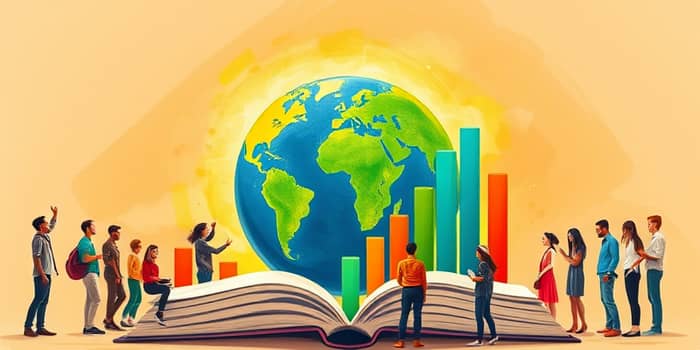
Across continents, education stands as a beacon of opportunity and a foundation for future prosperity. As nations seek sustainable development, the strategic allocation of resources to learning systems has never been more critical. By examining spending patterns, outcomes, and returns, we can appreciate education’s role as a transformative economic engine.
The scale of the education sector is staggering. Today, the global education market is valued at US$ 7.6 trillion global education market, underpinned by both public and private investments. Governments shoulder 60-70% of total education spending, reflecting a societal commitment to knowledge and skill development.
Private contributions, though smaller on average, amount to around 2% of global GDP, supplementing public budgets with innovative models and specialized programs. As digital platforms expand, the industry’s footprint continues to evolve, accommodating new learners and reshaping traditional paradigms.
Different segments capture varying shares of this vast market. A clear breakdown highlights where resources concentrate:
Overall, the sector enjoys a 4.4% compound annual growth rate, with K-12 expanding at 3.5% annually. Emerging economies, propelled by demographic dividends and digital infrastructure, spearhead this expansion. Yet, challenges such as labor shortages and shifting birth rates temper growth in developed regions.
The United States allocates significant resources to its schools and universities. K-12 institutions garner $878.2 billion, or $17,700 per pupil, funded by federal, state, and local sources. States contribute $383.9 billion, while local governments add $375.2 billion. Public postsecondary institutions average $30,228 annually.
When measured against other OECD nations, U.S. schools spend $20,387 per pupil, ranking third highest. Yet the U.S. dedicates only 12.7% of public funding to education, falling short of UNESCO’s 15% benchmark. Meanwhile, the nation invests 5.59% of GDP in education—above the OECD average of 4.9%, but leaving room for more equitable distribution.
Robust funding correlates directly with academic achievement. In states facing budget cuts, per-pupil reductions of $1,000 widened achievement gaps by six percentage points. Conversely, pandemic relief allocations yielded measurable gains in math and reading, particularly in under-resourced districts.
Long-term studies affirm that sustained investments yield profound benefits. A 20% increase in spending for low-income students over 12 years equated to a full additional year of schooling. A 10% boost produced a 7% rise in graduation rates and nearly a 10% increase in adult wages.
At the individual level, each extra year of education translates to roughly a 10% increase in annual earnings—surpassing average stock market returns. Graduates of any college program generate an estimated $73.4 billion in additional annual income compared to those with only a high school diploma.
Educated citizens not only earn more but also contribute higher taxes and reduce public spending on social entitlements. This virtuous cycle underscores education’s potency as both a personal investment and a collective asset.
Evidence from Asia and beyond demonstrates that education fuels productivity gains and fosters innovation. By equipping workforces with in-demand skills, nations strengthen their competitive edge in global markets. Moreover, every $1 invested in education can yield $10–$15 in long-term economic returns, making it one of the highest-yield public investments.
Beyond domestic benefits, cross-border education imports billions of dollars annually. International students contributed $45 billion to the U.S. economy in 2018, ranking higher education among the top five U.S. exports. Institutions such as Western Michigan University alone gain over $70 million and support hundreds of jobs through global enrollment.
Investing in education is not merely a moral imperative—it is a strategic economic decision. By channeling resources into equitable, high-quality learning opportunities, societies unlock human potential, drive innovation, and secure a more just and prosperous future. As global challenges intensify, the most powerful tool we wield remains a well-educated population capable of confronting tomorrow’s unknowns.
References