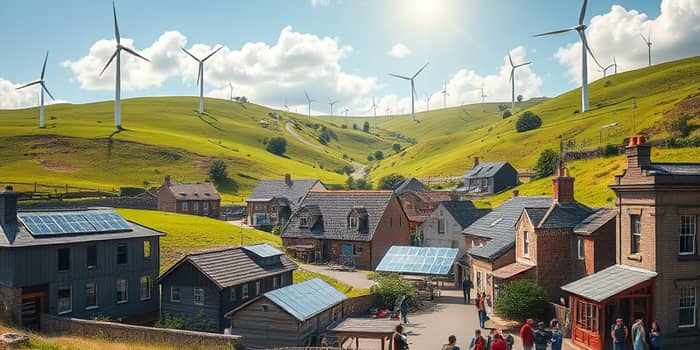
The global race to limit warming to 1.5 °C demands a rapid shift from coal and other fossil fuels to renewable power. Yet, for millions of workers and communities whose livelihoods depend on aging coal mines and power plants, this shift can feel like an existential threat. Ensuring no one is left behind or pushed behind is the linchpin of a truly sustainable transformation.
Financing a just energy transition sits at the crossroads of climate policy, labor justice, development finance, and macroeconomic stability. It offers a chance not only to decarbonize our energy systems but also to rebuild regional economies, create decent work, and heal social divides.
At its heart, a just transition ensures that the costs and benefits of climate action are shared fairly. It grew from labor movements in North America during the 1970s and 1980s, which demanded protection for workers affected by environmental regulations. Today, it underpins national climate strategies, international agreements, and community campaigns around the world.
These themes weave through every policy pillar, ensuring that historically marginalized groups—women, youth, Indigenous peoples, and low-income workers—receive priority attention, and that intergenerational fairness guides the pace of change.
Decarbonizing energy systems is a capital-intensive endeavor. Retiring coal plants, upgrading grids, deploying wind farms and solar parks, and building storage facilities all require vast sums of public and private investment. Without dedicated financing mechanisms, coal-dependent regions face economic collapse, rising unemployment, and political backlash against climate action.
By contrast, well-structured finance streams can unlock millions of new jobs in renewables manufacturing, operations, and maintenance. They can underwrite social safety nets, support small and medium enterprises in pivoting to green industries, and modernize infrastructure for a 21st-century economy.
Policymakers and financiers can anchor investments on five interlocking pillars:
These pillars guide everything from national transition funds to local regeneration programs. By combining economic planning with robust social policies, a just energy transition builds resilience and shared prosperity.
International agreements increasingly recognize the imperative of fairness in decarbonization. The Paris Agreement’s preamble explicitly calls for a just transition of the workforce and creation of decent work. Nearly 40 percent of Nationally Determined Contributions (NDCs) now reference just transition, and more than half of long-term strategies include dedicated measures for workers and communities.
The United Nations Development Programme (UNDP), World Resources Institute (WRI), and UN Department of Economic and Social Affairs (DESA) emphasize that aligning climate finance with social protection accelerates progress on the Sustainable Development Goals, from clean energy to reduced inequality.
Several architectures have emerged to mobilize the trillions needed for coal-to-clean transitions:
The European Union’s Just Transition Mechanism (JTM) channels EU budget grants to regions with heavy fossil dependencies. Through its Just Transition Fund, regional plans are financed for economic diversification, worker reskilling, land reclamation, and SME support. This mechanism leverages additional funding via InvestEU and European Investment Bank loans.
Multilateral development banks are also embedding just transition criteria into country strategies and project pipelines, ensuring that infrastructure and energy investments include social safeguards and community engagement.
Just Energy Transition Partnerships (JETPs) are multi-partner agreements that combine public and private capital to support emerging economies in decarbonizing coal while protecting vulnerable workers. The South Africa JETP, signed in 2021, aims to mobilize USD 8.5 billion. It finances power sector decarbonization, strategic investments in at-risk value chains like automotive and agriculture, and the development of decentralized renewable systems.
Subnational and national entities are also innovating. Colorado’s 2019 law created an Office of Just Transition tasked with developing a roadmap for coal communities, focusing on worker support and economic diversification. In the United States, 24 states introduced 138 bills on just energy transition in 2023, with New Mexico’s Energy Transition Act and Inflation Reduction Act bonus tax credits for clean energy in energy communities.
In Germany’s Ruhr region, coal mines have been repurposed into museums, green parks, and solar parks. Public and private funds coalesced to retrain miners as technicians, tour guides, and renewable energy specialists. The resulting transformation revitalized the local economy and created new cultural attractions.
South Korea’s coal communities are benefiting from a national just transition plan that invests in battery production and electric vehicle assembly plants. The government provides subsidies for reskilling and small business grants for entrepreneurs launching eco-tourism and sustainable agriculture ventures.
A successful just energy transition is neither automatic nor cheap. It demands political will, participatory governance, and innovative financing. Yet, the stakes could not be higher: delivering clean air, healthy jobs, resilient infrastructure, and a more equitable global economy.
By embedding equity and human rights lenses into every investment decision, stakeholders can ensure that decarbonization is not a story of winners and losers, but a collective journey toward shared progress. Coal-to-capital diplomacy, as manifested in JETPs and national transition funds, offers tangible pathways to mobilize the USD billions needed while strengthening social contracts.
Ultimately, the success of a just energy transition will be measured not only by CO₂ levels in the atmosphere, but by the livelihoods safeguarded, the new opportunities created, and the social bonds reinforced in communities once reliant on coal. By financing this transformation wisely and ethically, we can honor the principles of justice, dignity, and solidarity on which a sustainable future depends.
As policymakers, financiers, businesses, and communities collaborate, the shift from coal to capital becomes a powerful symbol: that climate action can—and must—uplift every worker, family, and region on our shared planet.
References