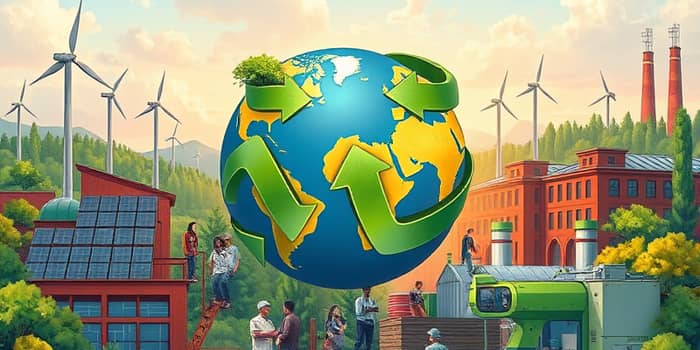
At the crossroads of environmental emergency and economic transformation lies the promise of the circular economy. By reimagining production, consumption, and resource regeneration, circular models can decouple growth from extraction and waste. Yet realizing this vision demands a fundamental shift in how capital flows are directed. In this article, we explore current financing landscapes, examine emerging trends, and outline clear pathways for investors, policymakers, and businesses to mobilize the necessary resources.
Resource scarcity, mounting waste streams, and systemic shocks now threaten both ecological balance and economic stability. Traditional linear systems have resulted in over 93% of materials becoming waste, exacerbating climate change and biodiversity loss. Meanwhile, geopolitical tensions and global health crises have laid bare the fragility of supply chains that rely on finite resources.
Transitioning to a circular model offers a dual advantage: it enhances resilience while driving progress toward net-zero targets. Yet the window to act is narrowing. Without decisive financial interventions to support material innovation, infrastructure upgrades, and service-based models, we risk locking in unsustainable practices for decades.
Between 2018 and 2023, circular investments reached over $164 billion globally, an 87% increase in investments since the previous five-year period. Despite this momentum, these flows represent just 2% of total global capital allocation. Most funding remains concentrated in repair, reuse, and traditional recycling, while high-impact areas—like circular product design and system transformation—receive a mere 4.7% of resources.
These figures reveal both encouraging growth and a critical funding gap. Accelerating impact areas requires new financing structures that reward long-term sustainability and systemic innovation over short-term returns.
As we look to 2026, three principal forces will drive circular financing:
Combined, these drivers will reduce perceived risks, attract mainstream capital, and expand the range of investable circular solutions across industries.
Geographic variations in policy ambition and market readiness shape where and how capital flows. In the European Union, ambitious recycling targets and mandatory reporting have lifted some member states to 15–31% recycled material use, well above the EU average of 12%. The UK’s Circular Economy Growth Plan allocates £10 billion to recycling infrastructure and rolls out a national Deposit Return Scheme to spur consumer participation.
Outside Europe, Australia’s National Circular Economy Framework focuses on harmonized metrics, while Latin American countries accelerate extended producer responsibility programs for packaging. North America sees state and provincial expansions of organic waste bans and e-waste recovery facilities, with the Royal Mint’s new e-waste plant in the UK demonstrating cross-border technology transfer.
Repurposing even a fraction of these €2.01 trillion in annual subsidies toward circular solutions could close critical financing gaps in biodiversity, adaptation, and infrastructure renewal.
Major barriers persist. Investors often favor low-risk, incremental improvements over systemic redesign, leaving transformational projects starved of capital. High innovation costs and long development timelines—for example, advanced battery recycling technologies—deter conventional lenders. Meanwhile, only 35% of municipal waste is recycled in OECD countries, highlighting the uneven pace of progress.
Further hurdles include data fragmentation, lack of standardized circularity metrics, and regulatory misalignment across jurisdictions. Without coherent frameworks, financiers struggle to compare risks, making it harder to build diversified portfolios of circular assets.
Reorienting finance toward high-impact circular initiatives demands collective commitment:
By leveraging these levers, financial institutions and public bodies can redirect capital toward projects that yield both robust returns and enhanced planetary resilience.
The convergence of policy momentum, technological maturity, and growing investor interest creates a once-in-a-generation opportunity. Embracing new revenue streams and reduced resource dependency through circular business models will redefine competitive advantage and societal well-being.
Now is the time for bold leadership: investors must expand their horizons beyond conventional assets, policymakers should implement ambitious, harmonized regulations, and businesses need to innovate across value chains. Together, they can forge a financial ecosystem that not only sustains economic growth but also regenerates natural systems. The future is circular—let us finance it today.
References