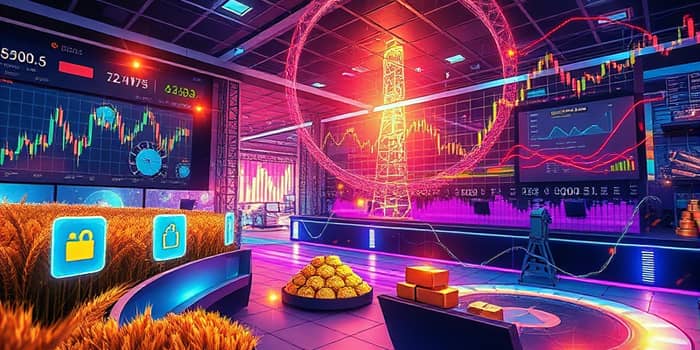
The global commodity futures market stands at the crossroads of ambition and security. Every day, millions of contracts are traded as investors and producers seek to harness price swings for gain or protect against sudden shocks. From agricultural harvests to energy production, these markets weave a tapestry of risk and reward that powers economies and livelihoods.
In these arenas, participants engage in price movements without physical ownership or use tools for mitigating price risk for producers, forging a balance between risk tolerance and market realities.
The term “commodity futures” refers to standardized contracts obligating buyers or sellers to trade a specific quantity of a raw material at a predetermined price on a future date. Speculation drives market momentum with strategic bets by allowing traders to profit from price changes, whereas hedgers use these instruments to stabilize revenue or costs. This dual purpose infuses global markets with liquidity and resilience, but also with inherent volatility that demands respect and rigorous analysis.
Since the nineteenth century, commodity futures have evolved from informal grain exchanges to sophisticated electronic platforms. Today, exchanges host 3-year high due to volatility in sectors like natural gas and precious metals. This evolution underscores how modern infrastructure and data analytics have amplified both opportunities and risks, calling for deeper insights and robust strategies to navigate an ever-shifting landscape.
As of 2026, the US Stock & Commodity Exchanges industry boasts a market size of $24.2 billion, supporting 8,490 businesses and registering a 28.9% CAGR since 2021. Trading activity on CME Group reached a natural gas futures/options average daily volume (ADV) of 1.3 million contracts in January, alongside energy options at a 500K daily ADV. Such figures highlight how driven by trends like energy transition these platforms have become critical barometers of global economic health.
Volatility remains palpable, with the Commodity Composite Volatility (CVOL) Index touching its highest level in three years. Weekly WTI crude oil options averaged 23,000 contracts—an 11% year-on-year rise—while electronic hedging tools have expanded, reflecting participants’ appetite for sophisticated risk-management tactics.
Speculation empowers traders to capitalize on shifts in supply and demand without ever taking delivery. These strategies often hinge on macro factors such as US-China trade dynamics, fiscal deficits, or unexpected weather patterns. For instance, long positions in WTI futures were notable when net longs fell to the lowest since before 2014, signaling a potential rebound for audacious speculators.
Copper options have gained traction as participants anticipate a 1 million-ton deficit in 2026, driven by electric vehicle and data center demand. Meanwhile, gold options spanning Monday to Friday capture volatility around Federal Reserve meetings. Each speculative play is a wager on market psychology and near-term catalysts, offering outsized rewards alongside amplified exposures.
By contrast, hedging anchors businesses against adverse price moves. Farmers and grain processors, for instance, hedge corn and wheat against volatile harvests, while oil producers employ weekly WTI options to guard against shifting Venezuelan output. Even precious metals like platinum face production constraints—highlighted by a multi-year supply deficit cushioned by recycling—prompting miners to lock in prices years ahead.
The decision to hedge transcends defense; it allows participants to plan capital investments, allocate budgets, and secure financing with certainty. It embodies a philosophy that values stability as much as it accommodates ambition, knitting together the risk-management frameworks vital to global trade.
The energy complex remains a central stage for futures activity, with oil and natural gas markets reflecting the tug of war between supply surpluses and geopolitical constraints. Traders and hedgers alike must interpret data points that hint at mid-year inflection points and long-term structural shifts.
This summary underscores the dual role of futures in the energy markets: hedging instruments to cushion price swings and speculative vehicles to capture turning points. As new LNG trains in Qatar and the US come online, low investor allocations point to opportunity for those equipped with the right insights and tools.
Across metals, looming deficits and central-bank demand fuel intense interest. Silver markets, in their seventh year of deficit, have seen ETF holdings climb to 830 million ounces from a 679 million-ounce trough. Platinum supply shortfalls are similarly structural, driving both forward contracts and long-dated options strategies.
In agriculture, record wheat production of 808.6 million metric tons in 2025/26 contrasts with low soybean exports unseen since 2012–13. High stocks-to-use ratios have tempered prices, but rising biofuel mandates and plant-based protein trends underpin renewed upside potential.
Volatility drivers such as weather anomalies, AI-equities correlations, and EU carbon pricing require vigilant monitoring. Options, spreads, and technical indicators, including cup-and-handle patterns and momentum oscillators, serve as essential tools for both hedgers and speculators.
Understanding when to deploy a time spread versus a short-dated option can spell the difference between a disciplined portfolio and a rollercoaster ride. With indicators suggesting a cyclical bull market emerging post-bear, market participants are keen to recalibrate their exposure.
The dual paths of speculation and hedging define the beating heart of commodity futures markets. Whether you aim to seize directional plays or secure cash flows, a clear strategy rooted in data and tempered by discipline is paramount.
As we look ahead to the remainder of 2026, remember that every contract, every option, and every spread echoes the collective expectations of millions. By combining rigorous analysis with emotional resilience, you can navigate these dynamic markets and stake your claim in the ever-evolving story of global trade.
Embrace the balance of risk and reward, and let commodity futures be the vessel that carries your vision forward.
References