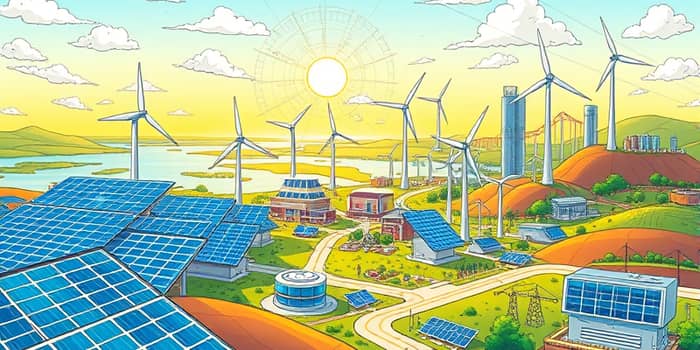
The global energy sector is at a crossroads. As nations grapple with climate imperatives and investors seek reliable returns, the traditional dominance of oil, gas, and coal is giving way to a transformative wave of clean energy deployment. In 2025, we stand on the brink of an unprecedented shift: capital is flowing into technologies that promise not only financial growth but also a sustainable future for communities worldwide.
This article unpacks the latest data, regional dynamics, emerging technologies, and practical steps for investors who wish to navigate the new energy landscape. By understanding where and how to allocate resources, one can align fiscal objectives with environmental stewardship in a rapidly evolving marketplace.
The International Energy Agency forecasts a record $3.3 trillion global investment in energy for 2025, reflecting a 2% consistent year-on-year increase despite geopolitical headwinds and supply chain challenges. This milestone underscores a decisive pivot: for the first time, electricity sector spend eclipses all fossil fuel outlays combined.
Industry trends reveal that clean energy capital allocation now commands two-thirds of new commitments, signaling that investors recognize the twin benefits of decarbonization and long-term cost efficiencies. From multilateral banks to sovereign wealth funds, the momentum is undeniable.
Investment in renewables is on a steep upward trajectory. In the first half of 2025 alone, global funding for new renewable projects hit $386 billion—a 10% rise from the same period in 2024. Solar PV is at the forefront, expected to account for half of all cleantech spending and two-thirds of new capacity additions.
Meanwhile, battery storage is evolving from a niche solution to a cornerstone of the energy system. Investment in BESS will surpass traditional pumped hydro capacity this year, with long-duration energy storage installations enhancing grid stability, smoothing variable output, and unlocking new revenue streams for developers and operators.
Offshore wind demonstrated robust growth as well, drawing $39 billion in the first half of the year—surpassing the full-year total for 2024. Coupled with behind-the-meter solar and storage projects, these trends reflect a broader shift toward decentralized, distributed energy systems that empower households, businesses, and communities.
In the United States, clean energy and transport investment reached $67.3 billion in Q1 2025, up 6.9% year-on-year. Retail-backed initiatives drove nearly half of this growth, while utility-scale solar spend dipped amid policy uncertainty and tariff debates. Wind power rebounded with a 26.8% quarterly increase, marking the third straight quarter of expansion.
Conversely, China continues to achieve exceptional capital efficiency, adding nearly twice as many gigawatts per dollar spent compared to the U.S. This contrast highlights the importance of policy frameworks, manufacturing capacity, and streamlined permitting in scaling clean technologies.
North American data centers are poised to procure approximately 175 TWh of incremental clean energy by 2030, leveraging innovative structures such as time-stamped renewable energy certificates and hourly emissions matching to align consumption with generation.
Beyond wind and solar, advanced nuclear is experiencing a renaissance. Global nuclear spending is set to exceed $70 billion in 2025, with growing interest in advanced small modular reactors that promise enhanced safety, lower upfront costs, and flexible deployment.
Green hydrogen is rapidly gaining traction, with electrolyser manufacturing receiving significant capital injections. Carbon management solutions, including carbon capture, utilization, and storage (CCUS), are also central to many industrial decarbonization roadmaps, attracting both private and public investment.
Project developers increasingly pursue hybrid models—integrating solar, wind, storage, and hydrogen—to balance intermittency, optimize asset utilization, and deliver stable, predictable returns in varied markets.
Seizing the opportunities in new energy demands a strategic, informed approach. Adopt a holistic, diversified investment portfolio that blends established renewables with high-potential emerging technologies.
The transition beyond fossil fuels is not merely a policy ambition—it is a powerful investment thesis. As global capital gravitates toward sustainability, astute investors can capture superior risk-adjusted returns while driving meaningful environmental progress.
By aligning financial objectives with decarbonization goals, we can unlock value, foster innovation, and accelerate the shift toward a resilient, low-carbon energy system. The horizon is rich with opportunity: solar deserts, offshore wind farms, hydrogen hubs, nuclear microgrids, and storage corridors all await forward-thinking capital.
Let us embrace this moment to build an energy ecosystem that empowers societies, protects ecosystems, and secures prosperity for future generations. The time to invest is now—beyond fossil fuels, into the limitless potential of new energy horizons.
References